

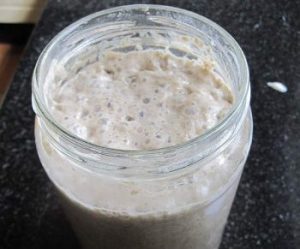
Kombucha sourdough is deliciously tangy, easy to make, and a great way to use extra yeast from your brew! Rather than throw them away, collect the brown strings of Kombucha yeast and we’ll show you how to make sourdough from Kombucha.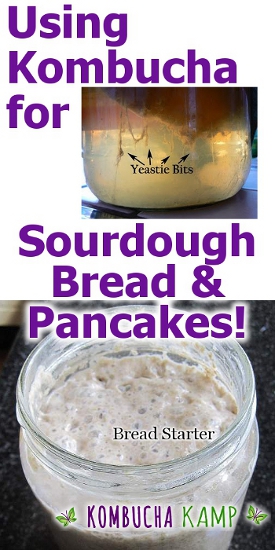
Yeast are a crucial component of Kombucha. They are the “Y” in Kombucha SCOBY! There could be no bubbles without the yeast. Plus they provide nutrition to us in the form of B vitamins.
But if left unmanaged, the yeast will overproduce and dominate. This throws the brew out of balance, which can lead to bad flavors or even mold.
As we do our regular maintenance on our SCOBY Hotel, or trim up the SCOBYs in our Continuous Brew, or even just filter out the extra yeast at the end of a Batch or CB round, saving it in a separate vessel and using Kombucha for sourdough bread is a great way to use up what would otherwise be waste.
Kombucha Sourdough: just another way the brew helps the environment!
The History of Sourdough
Historically, bread has been called “the essential food for most people for most of recorded history”. More simply, it’s known as the “staff of life.”
Although we still don’t know the exact origin of bread, recent evidence traced the oldest known flatstone baking to Jordan 14,500 years ago, more than 4,000 before agriculture.
While the most ancient breads were unleavened types similar to today’s pita and naan, the first record of leavened bread (with yeast) is sourdough made by the Egyptians around 4,000 b.c.e.
Bread Fun Facts
- The Old English word for bread was hlaf, which gives us the word “loaf”.
- Bread was such a precious commodity in the 16th century that bakers were often bankers, using loaves of bread as currency.
- During the California Gold Rush, miners were known as “Sourdoughs” for to the lump of starter they wore in a pouch around their neck to keep it warm.
- The most famous sourdough bread in the United States hails from San Francisco’s Boudin’s Bakery, which has maintained their mother culture for over 150 years, even surviving the Great Earthquake of 1906. The specific bacteria that thrives in their starter has been dubbed lactobacillus sanfrancisco.
- Think of all the cultural terms involving bread: breadbasket, bread-winner, putting bread on the table, bread and circuses, break bread, bread and butter, the best thing since sliced bread. (what did we miss?)

Egyptian hieroglyphics show evidence of baking.
Leavening and Yeast, Briefly
Leavened bread rises due to the presence of yeast. It’s what makes the large holes (aka crumb) in a well fermented Sourdough. Leavening occurs when wild yeasts populate a mixture of flour and water.
The yeast feast on the carbohydrates (sugar) naturally present in the flour. This (somehow) attracts lactobacillus, which creates a symbiosis (sound familiar)? Fermentation breaks down the naturally occurring phytic acid in the grain, creates a lighter texture (yeast release carbon dioxide that creates air pockets), and preserves the bread from spoiling too quickly.
 KMAMMA SEZ…
Yes, we said “somehow” the lactobacillus is attracted to the bread dough. That’s because nobody really knows how bread even really works yet! Scientists are trying to understand. They think maybe the bacteria were in the flour already, or come from our own bodies, or even the air around us. But really, they don’t know! What we are sure of is that the lactobacillus are the main source of the sour flavor of a good sourdough. Bacteria Powered!
Modern Bread
Most bread for sale today, especially at the grocery store, has undergone little-to-no fermentation, and may have added chemicals, fillers, or other artificial ingredients intended to standardize the otherwise artisanal process of baking or extend the shelf life of what is supposed to be a very freshly consumed product.
How else could they sell something via the supermarket that should be bought each day from the baker themselves?
And so many a homebrewer has wondered: can I make bread using Kombucha yeast? And the answer is yes! 🙂
Kombucha Bread Starter
*Used with permission from The Big Book of Kombucha
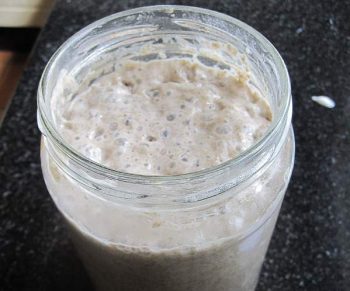
Use the excess yeast to start Kombucha Sourdough!


 (98 votes, average: 3.46 out of 5)
 Loading…
– Yield: 3 cups starter
– Prep Time: 5 minutes
– Cook Time: 3 days
– Total Time: 3 days 5 minutes
Ingredients
- 2 cups all purpose flour (THRIVE, AMZ)
- 1 cup sugar
- ¼-1 cup Kombucha yeast
- 1-2 cups Kombucha or Kombucha Vinegar (i.e. very sour Kombucha or Hotel Liquid), at room temp
Instructions
- Combine the flour, sugar, yeast and Kombucha in a medium nonreactive bowl.
- Stir to form a lumpy mixture.
- Cover the bowl with a cloth, secured with a rubber band.
- Leave at room temperature and stir once a day until small bubbles form in the mixture, which may take 3-7 days.
Feeding the Starter
Once it becomes bubbly, it may be used for baking but it is still weak. Taking the time to feed it for a few more days will ensure the best flavor and rising power.
Instructions
- Use a nonreactive container that can hold at least 3 quarts and has a tight fitting lid.
- Add 1 cup of flour and 1 cup of Kombucha or KV to the starter.
- Stir until well combined.
- Cover with cloth secured with a rubber band
- Leave at room temperature for 24 hours.
- Feed the starter again each day for the next 2 days.
At the end of the 3rd day, the starter will be robust and ready to bake!

Using & Storing the Starter Tips
- It may seem like you have more starter than you need, however 1-3 cups will be needed for each recipe included below. Every time some is removed to use for baking, replace with the same amount removed in order to maintain the supply. If you need more, add more without removing any and allow it to come up to strength.
- Between uses, store starter in tightly covered nonreactive container in the fridge. Yeast are temperature sensitive, so bring the starter back to room temp before using for baking.
- Starter will keep for 6 months in the fridge. The longer it’s stored the more sluggish it becomes.
- To restart, keep 3 cups of starter & discard the rest. Repeat the feeding process outlined above.
- Kombucha’s dominant yeast is Brettanomyces bruxellensis and may not have the same lift as Saccharomyces spp. If the bread is too dense, simply add some commercial yeast to the starter to create more airiness in the dough.
General Tips
- Letting the dough rise near your Kombucha brewing vessels is a good idea as it will capture wild yeast that is in the air.
- If after 24 hours the starter doesn’t have a ton of small bubbles and hasn’t at least doubled in size just feed it.
- As soon as it gets lots of small bubbles, and a nice sour smell then you have a mature starter and can bake bread with it.
- Store in the fridge between feedings. It will keep several months. To revive, remove from fridge and feed.
Here are a couple of great, simple ways to make use of that lovely sourdough Kombucha bread starter you’ve just cultivated!
Kombucha Sourdough Bread Recipe
*adapted from the Nourishing Traditions Cookbook by Sally Fallon
Makes 1 loaf.
- Starter should be room temperature and have been recently fed.
- Combine starter, salt and water in a large bowl and mix until the salt has dissolved.
- Slowly mix in the flour. It may be easier to use your hands.
- If the dough is too thick, add more water. The dough should be soft and easy to work.
- Knead in the bowl for 10-15 minutes.
- Shape into a loaf. Avoid pressing down on the dough to do this. Place in a buttered loaf pan.
- Cut a few slits in the top of the loaf.
- Cover with a cloth and let rise 4-12 hours (depending on temperature)
- Once it has doubled, then bake at 350 degrees for an hour.
- Allow to cool before slicing.
Here’s another great use for starter from fermentation buddy Sandor.
Alaskan Frontier Sourdough Hotcakes
*adapted from Wild Fermentation by Sandor Katz
Mix batter the night before for breakfast pancakes. Makes about 16 pancakes.
- In a large bowl, mix the starter, water, flour & sugar.
- Stir until smooth.
- Cover and let ferment 8-12 hours (overnight). **Don’t forget to replenish your starter.
- Beat the egg and add to the batter with the butter and salt.
- Stir until smooth.
- Mix the baking soda with 1 tbsp of warm water, fold it gently into the mixture.
- Heat a cast-iron pan or griddle and grease.
- Ladle batter into pan and cook until many bubbles have formed.
- Flip pancake and cook until medium brown.
- Serve warm!
Have you made Kombucha Bread before, or just want to try it?
Leave a comment letting us know how it went! 🙂






Cassie Manning
November 27, 2024 at 9:07 amI’m excited to try this kombucha sourdough! I’ve never done sourdough before, but my mother-in-law does a traditional sourdough and hers is amazing! So we are going to try them both and see what the difference is in flavor. I have a question, I am now at the point where I’m feeding my starter to make it more robust. I followed your starter recipe above, however, my starter is a little bit more on the runny side. Is this normal? Should I just add more flour to thicken it up?
kombuchaoffice@gmail.com
December 8, 2024 at 5:27 pmA runny starter is normal and can vary based on the hydration of your kombucha or vinegar. You can thicken it by stirring in small amounts of flour (1 tablespoon at a time) until it reaches a pancake batter-like consistency. Keep feeding it, and it should become robust in a few days.
As you continue feeding it over the next few days, it should naturally thicken and become more robust. A little variation in consistency is normal, so trust the process and let the bubbles guide you!
Hilda
November 2, 2022 at 4:17 pmI mixed this on October 20. It’s now 12 days and still the flour and liquid separate. I noticed some small bubbles coming from the bottom. Should I feed it with one cup flour and more KT?
Anthea Tayag
November 9, 2022 at 1:33 pmWe suggest feeding the starter more flour, adding a pinch of sugar and another cup of KT w/ yeast dregs if you have it available.
Michael
August 3, 2021 at 12:43 amDo you need the sugar in this recipe? Ordinary sourdough starter is just flour and water. Flour has sugars in it already for the kombucha yeast to eat. So flour and kombucha should be all you need.
Hannah Crum
August 17, 2021 at 5:35 pmThanks for that tip! We find the sugar helps to promote the growth of the starter from the beginning. Of course, everyone ought to experiment and find what works best for them. Anyone try eliminating the sugar? How did it go?
Mark
June 3, 2021 at 3:21 pmJust wanted to drop in and say that I gave this a try but I modified it and the results were fantastic. I’ve had a hotel going for a few months and needed to do a cleaning so the normal swap ensued. After filtering I was left with a few (ehh, ~5gs?) grams of yeasty goodness which I combined with 113g cheap bottom shelf whole wheat flour and 113g filtered water. WOW!! Not even 8hrs later it had grown 4x over. Feed it as a normal starter for a few days (AP flour/water) and it produced one of the most beautiful things I’ve made in my humble kitchen!
Ashley
November 14, 2020 at 2:01 pmThis was super easy. I used the recipe and made baguettes that were delicious!
Anita
July 14, 2020 at 3:14 amHi! I was on here, searching for an answer and saw someone else had my issue as well. I had removed my starter from the fridge and fed it so I could bake bread. I ended up not baking. Two days later I noticed some hooch on top, and when I opened up to feed the starter, I saw a scoby on top! At first I thought it was a thick layer of mold, but it wasn’t smelling off.
Now I’m wondering if I should remove the scoby, or leave it in there?
Hannah Crum
May 16, 2021 at 2:57 pmIf the SCOBY is thick, then go ahead and toss it so that the oxygen will assist with fermenting the flour.
Pam
July 6, 2020 at 7:52 amCan you make the starter using commercial kombucha?
Hannah Crum
May 30, 2023 at 12:36 pmYes – especially if it has yeasty dregs. If it is pasteurized or from concentrate, it won’t work. Here’s a post to help you tell the difference between commercially produced Kombucha based on the current labels.
Sam
May 26, 2020 at 1:26 amHello, may I know what it’s consistency is supposed to be? Mine appears to be a creamy-runny batter, and it separates into a watery layer on top and floury layer on the bottom within a few hours. Is this normal?
Hannah Crum
May 16, 2021 at 3:00 pmYes that’s normal, simply mix it back together so all of the ingredients are in contact with each other.
Bernadette Prunty
May 14, 2020 at 8:40 pmHi. I’ve just followed your recipe and made some lovely kombucher sourdough. I’ve put the unnused starter in the refrigerator. In a glass jar with a firm lid. I’m unsure what to do next. Can you please clarify. When I make some more bread in a couple of days, I understand that I use 3 cups of starter. Do I then leave the unused starter out of the refrigerator for 3 days and add 1 cup of kombucher and a cup of flour daily for 3 days as I did previously, and then put it back in the refrigerator?
Looking forward to your response.
Regards
Bernadette
Michelle Nelley
April 4, 2020 at 11:28 pmThank you so much for the information!
Mario
March 31, 2020 at 4:26 amHi. I was wondering if instead of collecting small yeasty particles you could just blitz a whole scoby? Or would that not work? I’m the most impatient man in the world and collecting those little bits would take forever. Thank you
Hannah Crum
May 16, 2021 at 3:08 pmThe yeast is more important than the bacteria, so we really want more yeast vs the pellicle which is primarily bacterial cellulose – that said, we are open to hearing about how your experiment blizting a SCOBY goes!
Rosemary
February 29, 2020 at 10:03 pmCould a person use organic all purpose flour to make the sour dough starter?
Hannah Crum
December 7, 2023 at 2:03 pmyes! we prefer it!
Eric
May 9, 2019 at 8:01 amDo you ever need to add sugar beyond the initial feeding to continuously sustain the sourdough starter?
Hannah Crum
May 24, 2019 at 9:01 amNot typically. It will feed on the “sugars” in the flour. If it seems weak, you might sprinkle a little sugar on top to give it extra nutrients.
Amy
March 30, 2019 at 10:16 pmHow do you store the kombucha yeast, until you have enough to make the sourdough starter?
Hannah Crum
April 14, 2019 at 7:26 amIt a glass container in the fridge with some Kombucha liquid to ensure it doesn’t dry out.
suzi
January 27, 2019 at 7:35 pmI am totally new at this and so have a question please!! I had bubbly starter and didnt have time to bake so stuck the jar in the fridge with a top that has a hope in the middle and a paper towel in between. does it need to breathe in the fridge? thats my first question!! secondly, I decided to take it out several hours later when I read it could sit for a week before baking. did the cold in the fridge harm it to the point I need to feed it again? how do we tell this sort of thing? thank you for helping me/us!!
Hannah Crum
February 5, 2019 at 5:09 pmAll good – we store our sourdough starter in the fridge and it doesn’t need a cloth cover, so that is perfectly fine to do. Simply start feeding it a few days before you are ready to bake and it will liven up.
Ashten
August 6, 2018 at 1:05 pmI’m a first-timer and am wondering what signs I should look for to know if the starter is ready. Whenever I check, there are always a few bubbles, but not many. It smells sour, but that could just be from the kombucha… any advice is appreciated!
Hannah Crum
August 27, 2019 at 11:22 amKombucha yeast is not as “springy” as other types of bakers yeast, so the fewer bubbles checks out. You can combine it with some bakers yeast if you want a lighter texture. We enjoy the denseness of the loaf – other flours will also provide a different amount of springiness as well. Give it a go and see how it turns out!
Rob
May 31, 2018 at 8:17 pmI followed the recipe for the starter and it bubbled quite a bit in the first 24 hours, however it did not rise. I then added 1/2 cup more flour and it seems to still be bubbling but not rising. Any advice?
Hannah Crum
June 28, 2019 at 3:17 pmThe yeast in Kombucha tends to yield a denser product than commercial yeast. You can add a pinch of commercial yeast to help with rise if a lighter dough is desired.
N Bell
May 6, 2020 at 2:31 pmI think you are asking if your starter should rise, and I will just say that mine didn’t rise but it did create bubbles, when I used it to make bread it rose really well and the bread was great… good luck!
Esbet
March 2, 2018 at 12:17 amHello, I have tried the sourdough starter recipe here and my sourdogh turn our amazing! With bubles and that great smell. So then I made a bread. It did grow at first but I baked it when it was twice the size and did not grow while baking. It did taste great but more a sourdough cake than a bread:) I think I put it too early in the oven. I guess the at least 4 hours is a must do. Don’t be hasty like me and wait at least 4 hours. I will make another one these days with a litlle more patience:)
Joy
January 8, 2018 at 5:23 pmDo you sift the flour when making the starter?
Hannah Crum
June 14, 2019 at 8:00 pmYou may sift if you like, but it isn’t necessary as you will stir it all together – there can be lumps, the organisms will find the flour!
Tamie
January 4, 2018 at 5:45 pmI was wondering if anyone has tried to bake it in the bread maker and if so how and was is successful.
Greta
December 17, 2017 at 9:41 amSo you literally mix KT with flour? Does the bread not taste like tea?
Hannah Crum
May 8, 2019 at 7:47 amJust like wine doesn’t taste like grape juice, Kombucha does not taste like tea. So when you add Kombucha to flour, it won’t have a tea flavor.
Janice Milne
November 1, 2017 at 1:25 pmCan you tell me how to feed the starter. Once I’ve taken out three cups for the first loaf, do I feed it just flour and how much daily….and do I add more Kombucha and how much and how often. Thanks Janice.
Hannah Crum
January 4, 2019 at 7:33 amFeeding the culture is easy. Add some flour and little more Kombucha every few days if activating or every few weeks if storing in the fridge.
jennifer
August 9, 2017 at 6:34 pmHi, I have a few questions.
How long can the starter sit on the counter without being fed? I left it alone on the counter for a couple of weeks without feeding, and it smells very tangy, but is quite bubble and more liquidy. If I fed it every day 1/2 cup flour, it was very thick and not bubbly.
Secondly, does the starter need to be stored in glass, plastic or metal? Does it matter? Because I know that kombucha should be in glass.
I’m so glad I found this recipe. I have so much kombucha, I’m trying to find different uses for it, and I love to bake, so making bread with the kombucha is beautiful 🙂 Thanks for sharing this recipe!
Hannah Crum
June 8, 2018 at 11:58 pmThanks Jennifer! We recommend storing the starter in glass as it is the least reactive material. As to how long the starter can be left unfed, its a tricky question. We’d recommend checking on it at least once a week so to see if it needs food. You can also store it in the fridge for a longer time. Of course, if you forget about it, you may be able to revive it provided it is free from mold.
Daniel stockdell
May 27, 2017 at 8:06 amThree-step bread fermentation
I live in Brazil and when I first tried to bake sourdough bread here I was very disappointed with the small rise I obtained compared to what I had in Alaska. I decided to add some Fleischmann’s and got both the tart sourdough taste and the light fluffy texture. After brewing Kombucha for some time I added it as well and found that the bread stayed moist longer and had added flavor value. My practice now is to begin the day before with my yeast starter which I have maintained for many years. The next morning when I add fresh flour I also add a cup of Kombucha (so the old yeast dominates) a while later I add the commercial yeast. Then when I see that expanding I add flour while kneading and form loaves.
I decided to mention this alternative after reading of someone who threw away an old yeast culture. Not Necessary!
Tamara
January 17, 2021 at 7:34 amHow much commercial yeast do you add please ?
Jacqueline
May 26, 2017 at 5:59 amHas anyone tried making KT bread in a bread maker once the starter is ready?
Esther Huckabay
May 3, 2017 at 2:50 pmI am in the process of bottling my JUN (green tea and honey) kombucha home-brew, and am interested in collecting the yeasty globs on the bottom of my brew to make sourdough bread starter. Does anyone know if JUN brew yeast works just as well? Also, I’d prefer to use a non-wheat flour for the sourdough bread- such as rye, spelt, and/or millet. Has anyone done this successfully? Any suggestions? Thanks!
Hannah Crum
May 3, 2018 at 5:30 pmThe yeast we collect from the SCOBYs and JUN cultures may be combined together – they will not rise as much as commercial yeast do and make a lovely, rich flavored bread. We have yet to perfect a gluten free sourdough recipe but are confident they are out there. A great resource to start with is Victoria Redhed Miller’s new book “From No-Knead to Sourdough.” She has an entire section on gluten free breads.
Karen
April 18, 2017 at 5:23 pmCan this work with gluten free flour?
Hannah Crum
April 18, 2018 at 5:38 pmYes! We’ve been perfecting our GF flour version of the recipe and will be sharing it soon!
Jody Langdon
August 29, 2015 at 5:05 pmI have tried both the bread and the Hot Cakes and OMG the hot cakes are the best! Thank you kindly for sharing this ‘must keep’ recipe, love your work! Xx Jody
Terri
July 19, 2015 at 12:53 pmAARGh – why didn’t I check BEFORE I threw the KT yeasty dregs down the drain? I suspected I could have used it to make sourdough. Sigh Never mind – there’ll be lots more to come I’m sure, and I’ll definitely give this a go next time the yeasty stuff needs a clear out from my brew.
Melanie
July 9, 2015 at 11:48 amI have been trying to make a starter for the first time and it has formed its own scoby on top! I started with home made brown rice flour and kombucha and was feeding it 1/4 cup of rice flour and 1/4 cup of water twice a day for 4 days and then 1/2 cup of each per day. It began bubbling a little after 4 days but has now stopped completely and is growing a thick scoby. I thought I may have been feeding it too much so I haven’t fed it in 2-3 days. It’s been about 2 weeks all up now…. what did I do wrong and is there any way to save it??
Hannah Crum
July 9, 2015 at 12:46 pmWe’ve not worked with rice flour before. In the sourdough starters we have made, we’ve also never had a SCOBY grow. So we did a a quick comparison of wheat and brown rice in terms of macronutrients, it appears that brown rice has significantly lower amounts of protein. This difference in nutrient composition may be causing the Kombucha to treat the brown rice flour as a sugar source, hence the culture formation. This is a great inspiration to try to create a gluten free Kombucha sourdough starter!
Beth
July 7, 2015 at 8:33 amAs I write this, I am eating a warm slice of my first loaf of Kombucha bread that I just baked! Yummy!!! I made RYE bread using half white flour and half rye flour. I even added caraway seeds to the dough before baking. The flavor is outstanding!!! I am so excited that I can bake with kombucha and well as drink it.
Lola
June 1, 2015 at 10:13 amI would like to know if you can make gluten-free bread with the KT bread starter? Thank you very much!
Hannah Crum
June 8, 2015 at 10:29 amGive it a go! Let us know how it turns out =)
Laura
April 23, 2014 at 1:24 pmI love all the uses for Kombucha and have experimented with sourdough bread. I have found that if you use kombucha yeast for the starter, the bread takes longer to rise, but has more flavor. Also, if you have a recipe that call for adding packaged yeast to a starter made with kombucha, it doesn’t work as well as adding a bit more kombucha yeast. I think the organisms are probably a little different and don’t work together as well.
Hannah Crum
April 25, 2014 at 5:08 pmThanks for sharing your experience! Wild yeasts will behave differently than commercially produced ones but the health benefits & flavor will outmatch their commercial counterparts. Anyone else care to share their experience with their Kombucha sourdough starter?
Alan
March 13, 2014 at 1:29 pmMaking that bread do you really have to kneed it in the bowl?
Wouldn’t be just as good using a dough hook in a mixer?
I want to do this but I also want to do it as easy as I can.
Hannah Crum
March 17, 2014 at 2:59 pmGive it a try and let us know how it turned out – happy baking Alan!
Brianne
November 15, 2013 at 10:09 pmI’ve been using this recipe for my first attempt at sourdough, using my kombucha and it seems to be working well, but I’ve noticed that my starter separates. It doesn’t even take 12 hours after stirring it and feeding it for it to separate again. It ends up with starter on top and a layer of light colored, sour tasting liquid on the bottom. I’ve tried pouring it out but the layer of sticky starter on top prevents it from getting through, so I’ve been just stirring it back in. Is this normal?
kkadmin
November 26, 2013 at 2:09 pmYep, stir it back in!
Alan
November 15, 2013 at 10:59 amI always get some of those yeasty globs every time I decant kombucha. Would they survive if I just started collecting them in a small jar? Should I keep them in a little kombucha? On the counter or in the fringe? Give them a taste of sugar? I have never done sourdough any way so being a strong kombucha guy I really should start this way.
I REALLY need to do a clean out of my 2 1/2 gallon crock. That SCOBY is taking it over. I am down to a three quart max brew now. The rest of the crock is full of SCOBY. I could get enough yeasty bits that way but i am really wondering about the best way to save up the ones I get so often as I bottle up my brew.
kkadmin
November 21, 2013 at 2:09 amYou could certainly save your yeastie bits. They’d probably best serve you as a source of living B vitamins. Dehydrate them or toss into smoothies!
Lynne
November 7, 2013 at 9:23 amI have made the bread and hotcakes with great success. Thanks for the recipes. Any thoughts of how to make cinnamon buns from sourdough starter?
Jesse Loren
October 14, 2013 at 2:41 pmHannah, this is brilliant. I’ve been making KT for 4 years now and just got the idea for bread. I thought… maybe KT could do it. KY does everything! Then I found your site. OMG I mixed my KT in and it instantly looked like pancake batter, bubbles and all! I hope for some super duper KT powered, scobified bread.
Last thing, what is the best container? I am sort of out of jars right now between making KT, yogurt, and collecting honey. Can I use plastic? Thank you Hannah the KT goddess!
Hannah Crum
October 22, 2013 at 8:29 pmWe don’t recommend plastic for long term storage, but it certainly will work in a pinch.
rosalie
September 23, 2013 at 12:28 pmi was wondering, if the starter is bubbly does that mean it is matured? or is there another sign you have to look for before making it into dough and whatnot?
Missy
June 3, 2013 at 12:14 pmOk- how about a recipe for flat bread and/or pizza dough too.
Missy
June 3, 2013 at 12:15 pmoops- for forgot to say please and thank you! 🙂
Carina
April 28, 2013 at 5:54 pmMost awesome recipe google search has ever provided me! Someone said their starter had protective SCOBY superpowers and they are absolutely correct 🙂 My whole kitchen looks like a science fair now; crocks, jars, brewing vessels, buckets, and now two very happy sourdough starters AND two loaves of bread rising on top of my stove. Thank you so much for providing this very useful and simple (simple in a good way where the imagination can run wild with it!) recipe!
Brenda Hoffman
April 16, 2013 at 9:35 amThis is great news. I wanted to start making homemade bread again, but want to make healthy sourdough. I’ve never worked with a starter before so I guess my first try will be with Kombucha yeast when I do my first cleaning of my continuous brewer. Thanks for the article!
Erin
April 1, 2013 at 6:40 amthanks! I actually did bake with the starter the next day and it was the best bread I’ve made so far!
Erin
March 1, 2013 at 12:03 pmI’ve baked this bread with good results most times. I think that adding a little sweetener helped it not be sooo sour. I even tried making raisin cinnamon bread–so, so… I’ll have to keep trying and perfect that recipe! It’s a great starter though and very simple. I do have a question: I have a starter that I made a few days ago. It reached it’s “maturity” a couple days ago, but I forgot to put it in the fridge. Now the starter is smelling really strong–sort of like alcohol. Is this still safe to use?( My house is kept between 60-65 degrees, in case that matters.)
Hannah Crum
March 3, 2013 at 7:49 amThe alcohol smell is due to the activity of the yeast. Any alcohol created by the starter will be baked out of it.
Deidre Lin via Facebook
December 10, 2012 at 4:32 pmwow..good idea!
Turshá Hamilton via Facebook
December 10, 2012 at 2:47 pmCool!
Christine Clarey Decarolis via Facebook
December 10, 2012 at 2:32 pm@Monica–yes, feeding means adding both flour and water. Usually about as much water as you have starter and twice as much flour. This website is an excellent one for explaining everything you wanted to know about sourdour and more…http://www.sourdoughhome.com/index.php.
Monica Oxendine via Facebook
December 10, 2012 at 1:51 pmdoes feeding it mean adding more flour
Goran Zec via Facebook
December 10, 2012 at 1:37 pmIf you just use the yeast, it’ll still take some time for it to mature and stabilize. Basically, the best way to make a starter is just leave the wet flour to spoil, then salvage a bit and mix into a new batch of wet flour to spoil. When it starts smelling less like feet and more like one of those rich creamy French cheeses that smell like feet, it’ll incidentally also start raising bread.
Jessica Thompson via Facebook
December 10, 2012 at 1:28 pmThis is awesome, I just was researching where I could get a sourdough starter, and I can use the yeast from my continuous brew to make some…SCORE!
Goran Zec via Facebook
December 10, 2012 at 1:21 pmYou can bootstrap a decent starter quickly with kombucha. I had a mature starter which over time obviously mated with kombucha and developed protective scoby superpowers. Mind you, it’s not only yeast, it actually develops the white bacterial pancake on top and you can use it to ferment tea.
LaMyra Morton via Facebook
December 10, 2012 at 1:18 pmThank you. I was just getting ready to throw mine out.
Adalberto
July 5, 2012 at 1:45 amI’ve been culturing my own sourdough starter for the last 2 years but, guess what: I’ve literally thrown it away (in the compost) after trying with Kombucha!
I prefer to use the Biga, the Italian traditional preferment, which works best with weak flours.
So I mix 2 parts of flour to 1 part of KT the night before, then let it sit overnight at room temperature. In the morning it is doubled, and much softer, so I just mix it with another 2 parts of flour and 1 & 1/2 parts of water, plus some salt.
The rest goes as it usually did for me: KT has just simplified my bread baking work, while at the same time making it more tasteful!
Hannah Crum
May 21, 2015 at 2:44 pmKT is short for Kombucha Tea
Jessie Demos Wicker via Facebook
May 21, 2012 at 1:32 pmOh hell yeah. Tried to make starter 3 times and failed. Will try this!
Monica T Oxendine via Facebook
May 21, 2012 at 12:50 pminteresting
Shellie
January 25, 2012 at 12:29 amThanks a lot for the idea…I am sure that this can be perfect this coming weekend…Great job as well!!
Pine Crooks
January 22, 2012 at 9:31 pmI have a question. When you feed your starter with more flour, won’t you also need to add more liquid. Should you use warm water, or kombucha, or yeasty kombucha from the bottom of the jar? I am eager to try this bread!
hannah
January 23, 2012 at 12:46 pmI add a mix of Kombucha and water when I give it the new feeding. As you accumulate more yeast, then add that in to your starter as well to keep it active.
Pine Crooks
January 23, 2012 at 11:44 pmThank you Hannah
GIULIO
January 29, 2012 at 1:00 pmHI hannah , one more question. How long can survive then the sourdough?
hannah
January 30, 2012 at 1:41 amIt will survive in the fridge for a few feedings – it may last longer if you care for it properly.
Khriscia
January 11, 2012 at 10:17 pmI am not good in cooking but I hope this can really help me a lot…Thanks!!
Toby Rey
January 7, 2012 at 10:15 amCan this be used replacing the flour with a gluten free substitute? And thanks for the recipe…my wife bakes and I just told her about this option. Beginning to peak her interest in this.
Kay
April 8, 2014 at 7:07 amI would like to know too. I am on GF diet and miss having a sandwiches. 🙂
Cheryl
May 15, 2015 at 5:12 pmAs long as the yeast can extract food from the flour, it should work. I would try a brown rice flour or something like that first to see how it goes.
tina
March 29, 2016 at 6:57 pmI’ve been making sourdough with millet flour (though haven’t tried with kombucha yet). works fine and awesome bread.
Diana Grant
December 30, 2011 at 9:04 amI am not familir with this recipe and I want to thank you for sharing it to us…The idea is awesome too…
Gretchen
December 2, 2011 at 10:08 amLooks great Hannah, thanks for posting.
Mariellen Supple Gallaher via Facebook
December 2, 2011 at 7:27 amLove this idea … gotta remember it in 3 mo when my CBS vessel comes due for semi-annual cleaning. Love the festive punch recipes, too!