



Back to School
SALE
-22%
Back to School
Glass Continuous Brewer Kombucha Deluxe Package
GLASS VESSEL SPECS Capacity: ~2.2…
Original price was: $429.94.$333.88Current price is: $333.88.
View Details

Back to School
SALE
-11%
Back to School
JUN Brew Now Jar Kit
JUN JAR KIT FEATURES 1…
Original price was: $111.00.$98.88Current price is: $98.88.
View Details

Books, Courses & Support
SALE
-50%
Books, Courses & Support
Secrets of Kombucha Tea Course
Serving As Teacher And Mentor…
Original price was: $50.00.$25.00Current price is: $25.00.
View Details






nadine
June 15, 2025 at 7:35 amI have made Jun for a long time. I make it with raw honey and loose decaf organic green tea (C02 processed) and have very healthy, robust scobies.
kombuchaoffice@gmail.com
June 16, 2025 at 9:49 pmThat’s awesome Nadine! Glad to hear its working for you.
John
December 20, 2024 at 7:41 amHi, thanks for this very informative article. I was concerned about drinking Kombucha after 3pm, but now am not. I also have been adding some Rooibos to every batch I make because I really love the flavor. It is low, maybe 5%-10% of the full tea amount, so I am not too concerned with using it every time. The other 95% is usually a mix of black and/or green.
Becki Burman
November 16, 2022 at 12:41 pmSo, if you use tea blends, or herbal teas for a batch, do you use your black tea starter, or can yuou develope a blend or herbal starter for it? Which is best? Thanks
Anthea Tayag
November 16, 2022 at 4:39 pmCaffeine (in tea) is required for the SCOBY to survive, so we use a blend of caffeinated teas (black, green, or white). Flavored teas or herbal tisanes (many “flavored teas” are actually just herbs, not real tea) may contain oils that may act as antibacterial agents and is best to use as flavoring in the 2nd ferment.
Florian Rücker
April 7, 2021 at 2:38 amHmm I actually came here trying to learn about what the Kombucha fermentation does to the L-Theanine content. You have a whole section on it, but don’t discuss that.
Because if the fermentation *doesn’t* lower the l-theanine content, that would be potentially pretty amazing (better caffeine:l-theanine ratio after fermentation).
Any idea?
Hannah Crum
December 7, 2023 at 1:58 pmThat would be fascinating to uncover! Looks like we need more research on the topic =)
Ava
January 20, 2021 at 6:35 pmSuper helpful! Thank you!! I have a beautiful aged organic earl grey tea with real organic bergamot. Do you think that would be ok to brew for kombucha, or would there be some problematic citrus oils? I will get some other kinds of tea as well, for variety. I am finally starting to make my own kombucha, which I should have done long ago. I signed up for your emails and really appreciate this resource.
Hannah Crum
February 20, 2021 at 9:05 amTry it out with a spare SCOBY from your SCOBY Hotel. Let us know how it turns out!
Hoku
September 2, 2020 at 10:06 pmWe have been making our own Kombucha for awhile now. We started with Pu-er tea and switched to Rooibos. The taste is amazing. However, after reading several articles we’ve learned that the SCOBY needs caffeine every now and then. Question: Can we use caffeinated tea in the SCOBY hotel and then continue making our brew using Rooibos tea? We could rotate the SCOBYs through the hotel. Thank you!
Hannah Crum
May 16, 2021 at 2:53 pmYou may be surprised to discover that your culture may adapt completely to the new substrate. If you notice the cultures are getting weaker and the flavor isn’t developing, then mix in a teaspoon or two of actual tea (camellia sinensis) to revive the culture.
MythMythos
September 30, 2019 at 4:26 pmThank you for the very informative article. I love kombucha. Yet I’m one of those sensitive Sally’s when it comes to caffeine so I’ve been so hesitant to drink kombucha often.
The information you gave has allowed me to enjoy one of my favourite drinks again. (with caution of course lol)
Steve
March 20, 2019 at 11:41 amThank you for this data and experience.
Sarah
January 17, 2018 at 2:01 pmI accidentally made a batch of kombucha with decaf tea (2 days ago). Should I dump it out and start over? Will my SCOBY die if I keep the batch going? Is there any hope that this batch could be successful?
Hannah Crum
June 14, 2019 at 7:56 pmAll good. Use caffeinated tea or a blend of both in your next batch. Kombucha doesn’t contain a lot of caffeine, even though its made from tea.
Dee
February 15, 2020 at 11:43 pmDid the decaf batch turn out ok? Would love to try making some if it did!
Camilo
September 20, 2017 at 8:08 amVery informative article. Good to know that the caffeine is so much lower after fermentation. I have been using Hibiscus flowers and berry teas (decaffeinated) as well regular black tea, The flavor is better than commercial Kombucha. Thanks for the helpful articles. I totally love Kombucha and my family and I are enjoying the healthy delicious benefits of this drink which until recently was totally unknown to us. Sodas and sugary drinks totally out.
Phil
August 12, 2017 at 7:49 amMy understanding is that caffeine is necessary for making the best KT because the scoby inhabitants ingest & transform it. And so that’s why the tea has less caffeine than the tea it was made from!
Hannah Crum
May 23, 2018 at 6:50 pmYes! That is correct! Just like caffeine stimulates our nervous system, it also gives the yeast a jolt of energy and spurs them to ferment more quickly while also using up the caffeine from the tea so there is less in the final product. The benefit is that the yeast help to lower the pH and protect the brew from mold. Kombucha can also be made with caffeine free teas but if the fermentation seems stuck in any way, using tea with caffeine will help to spur it along. T
Christy
May 1, 2014 at 7:49 amThank you for the tips! I get terrible cyclic breast pain and even had to have a mammogram. Was certain I had breast cancer or something awful and my doctor told me to cut out caffeine and issue resolved. I find it annoying when people say “Why wouldn’t you love caffeine?” Or when I’m getting my decaf coffee people say “what’s the point of that if you’re drinking decaf” I wish it wasn’t an issue, but it is! Already drinking kefir water and would love to get into kombucha! Thanks!
Chelle
April 22, 2014 at 3:41 pmI have read that instead of using the 4th cycle to do a caffeinated version you can just use 75% herbal or decaf with 25% caffeine and this will have the same effect on the Scoby. I am not super caffeine sensitive just trying to avoid it at the direction of my naturopath – however I just like being able to have a nice beverage as I’m not allowed any artificial sweeteners either. Will the 25/75% work?
Hannah Crum
April 25, 2014 at 5:06 pmExperiment with extra cultures from your SCOBY Hotel and then report back to let us know how it turned out!
Karri
April 15, 2014 at 11:02 amIf I use the “steep and dump” method do I still need to do a full caffiene batch every fourth time?
Hannah Crum
April 15, 2014 at 12:42 pmDepends on how your culture growth is coming along. If you have thin & weak SCOBYs, then yes – they need nutrition. If the SCOBYs are healthy & thriving, then you are good!
Meg
April 1, 2014 at 10:23 amMy heart is pounding as I type this after having a glass of Kombucha with breakfast. I’ve been making my own Kombucha and love it, BUT the caffeine is really making my heart pound. I will try the recommendations to reduce the caffeine and truly hope it works because I LOVE Kombucha!
Hannah Crum
April 8, 2014 at 6:05 pmTry diluting it in water to see if that is easier on your body. Trust YOUR Gut!
Mary
August 7, 2013 at 10:34 amI recently heard of making Coffee Kombucha…you use brewed coffee in replacement of the brewed tea. Have you heard of this? Will it work? Is it good? I like coffee and was curious. Thanks.
Hannah Crum
August 9, 2013 at 2:06 pmThere’s an interesting article & recipe about Coffee Kombucha at the KommUnity.
Ilona
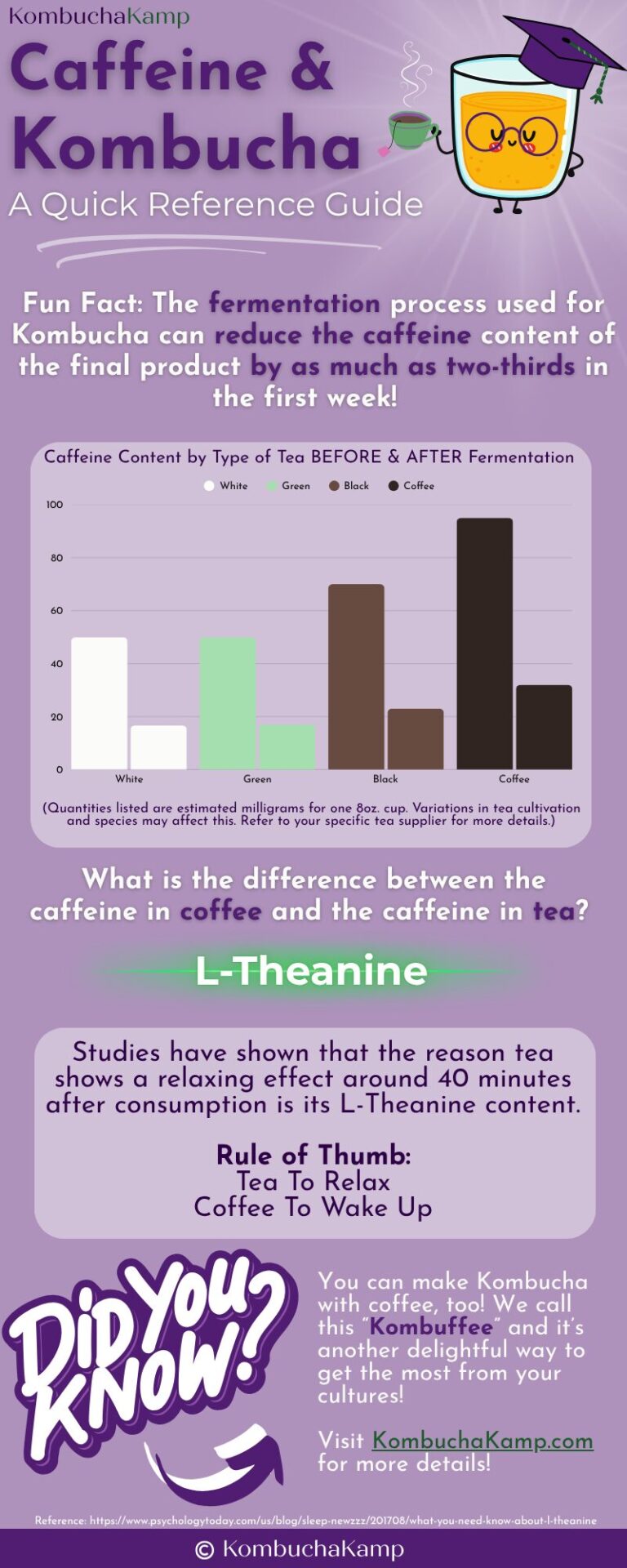
May 15, 2013 at 12:22 pmI think that kombucha has less caffeine simply because of the tea to water ratio: allowing for recipe variations, there is a large difference between them. A typical kombucha recipe may call for four tea bags to three quarts of water versus the one bag to one cup of water that one might use for tea. A cup (eight ounces) is a quarter of a quart (thirty-two ounces), so a brewer would need to use twelve bags of tea when making kombucha in order to end up with the same amount of caffeine as is contained in tea.
Hannah Crum
May 15, 2013 at 12:32 pmYes – that is an astute observation. The amount of tea used for 1 gallon is far less than the ratio of 1 tea bag to 1 tea cup.
Noah Pardo-Friedman
May 8, 2013 at 2:10 pmI’ve yet to find definitive evidence that kombucha has less caffeine than the tea with which it was made. Not that I believe this not to be the case; I don’t know for sure one way or another, as I’ve read conflicting opinions on the topic, but neither side has ever presented hard evidence to back up their claim. My hunch is that, since the SCOBY feeds on sugar, it shouldn’t have an effect on the caffeine content of the finished product, but I’m open to evidence that’s been collected to the contrary (or in confirmation, for that matter)–can anyone provide some?
Enid
April 29, 2013 at 5:57 amI’m new kombucha lover, I just make my first kombucha tea, but I didn’t know about decaf process and use decaf green tea for my culture.
Did anyone brewing decaf kombucha? Please help me, I don’t want to kill my SCOBY!
Hannah Crum
April 29, 2013 at 5:45 pmOne batch will not likely kill your SCOBY, but over time, it could atrophy. Switch to regular tea for your next batch and keep on a’brewin!
Winter
January 18, 2013 at 5:35 pmThanks for this info on brewing decaf kombucha!! I am one of those unfortunate people who gets severe migraines when I consume caffeine! I really want the benefits of drinking Kombucha, and am excited to try brewing my own!
brian
November 27, 2012 at 6:53 pmI’m not sure when this blog was written, but I wanted to comment on the decaf matter. I am also very, very sensitive to caffeine. I can get a headache from half a cup of green tea, I also love kombucha, so I am very motivated to find the solution to this issue.
Twinings is one company that uses water and CO2 to decaf their tea. They say that is does not leave a residue and leaves 95% of the polyphenols and flavor qualities of the tea.
I just tasted a batch of kombucha I made with their english breakfast decaf, after 4 weeks it is excellent and ready for bottling. (I often do a secondary fermentation with fruit juice, I like the carbonation and flavor this provides.)
If anyone has any more info on the decaf situation, please post!
Hannah Crum
December 4, 2012 at 6:27 pmWe’d be curious to hear how your culture fares over time without caffeine. Do keep us posted!
sam kaffine
November 3, 2012 at 9:37 pmAWESOME – thanks SO much for the info, Hannah – I recommend you to everyone I talk to about my new obsession. Thanks for supplying me with the knowledge and confidence to supplement my diet with a healthful and delicious beverage!!
Ruth
June 6, 2012 at 8:34 amMy heart cannot handle caffeine. Even small amounts of caffeine give me heart palpitations or a highly elevated heart rate. Thanks for the tips. I will try it with herbal tea and use the caffinated tea every fourth time. My family can drink the caffinated batch.
Pat
April 16, 2012 at 2:47 pmI’m just beggining to make Kombucha again, but years ago I used Kukicha twig tea, which has much less caffeine, and it worked fine.
hannah
April 16, 2012 at 3:03 pmThanks for the tip Pat!
jak
September 6, 2012 at 9:15 pmi made my first batch with twig tea (organic african nectar) last month ’cause we didn’t want any caffeine as our little kids drink some – we now have a ton of SCOBY!
cool site! thanks for doin’ it
hannah
March 17, 2011 at 3:07 pmOolong is a popular tea base for many of the commercial brewers. Its also the tea most commonly served in Chinese restaurants. How did your batch turn out Ant?
Ant
March 7, 2011 at 4:03 pmCaffeine is technically a drug & it alters various physiology. Also note that caffeine affects the liver. The “sugar” hit people get from having a coffee (& cake), even if they don’t have sugar with it, is the release of sugar by liver from the caffeine. I was told this by my naturopath a while back. Hence, that is why diabetics (T1 & 2) are told not to have caffeine, even green tea, due to this sugar spike effect. Its not that people “fear” caffeine, it affects you in many ways, even with healthy people. If you come off having it, most get a headache. That is clearly a cellular detox effect. I simply try to avoid caffeine, so my latest brew is an oolong tea batch, cant wait. From my research it is lowest in caffeine & a pure tea, so should be ok.
hannah
March 2, 2011 at 10:04 pmJust trying to do my part – people want to know – I’ve got to speak up! =)
Хэлэна Коронадо Салазар via Facebook
March 2, 2011 at 8:31 amWhy anyone would fear caffeine is way beyond me! =p
Amber
September 5, 2013 at 7:50 amI have a terrible reaction to caffeine. Hence why I am on this site looking for a caffeine free alternative. I get heart palpitations, hot sweats and feel awful from a cup of green tea, a couple swigs of coffee, or even a from chocolate. This only came on in my twenties.
Kit
November 22, 2018 at 9:26 pmMaybe because for some of us it causes diarrhea that does not want to stop. Grumpy guts unload whenever they please and care nothing for the esthetics of the situation or dignity of their victim. However, where kombucha is concerned, I’ve found that if I behave myself and only take a swallow or two at a time, I tolerate it pretty well.
Hannah Crum
December 1, 2018 at 1:03 pmTrust YOUR gut!
Eros Bongiovanni via Facebook
March 2, 2011 at 7:57 amThis is extremely helpful. Thank you!