Are you a Microbe Master? Take Our 8-Question Quiz and Start Brewing Today!
If you’ve ever Googled “Is Kombucha safe to brew at home?” you’ve probably seen it all:
Deep breath.
Kombucha has been brewed safely in homes for thousands of years.
It’s not a biohazard, it’s a kitchen ferment.
At Kombucha Kamp, we’ve supported hundreds of thousands of brewers worldwide.

We’ve seen every weird SCOBY, every brewing mistake, and every panicked email that starts with, “Help, is this normal?!”
This guide is the conversation we’d have if you were standing in our kitchen, SCOBY in hand, asking:
“Okay, be real with me — is this actually safe, and what do I need to watch out for?”
Let’s walk through it, step by step.
Short answer: Yes.
Longer answer: Kombucha is safe because it wants to be safe.
Kombucha is a living ecosystem that naturally creates conditions hostile to the “bad guys”:
So instead of being fragile, Kombucha is surprisingly self-protective — as long as you give it what it needs:
You do not need a lab, a hazmat suit, or a sterilized bunker. I promise.
The way that I like to conceptualize this process for the newbie who is just getting into home ferments is by letting them know (as many times as it takes to sink it): Humans have been fermenting for thousands of years. If our ancestors could ferment on dusty trails inside of animal stomachs, you can ferment in a comparatively sterile modern kitchen with tools specifically designed for the job.
You just need to understand the handful of things that actually matter. That’s why Kombucha Kamp exists.
Here’s the “why this works” piece — no degree required.
When you brew Kombucha, three main things are happening:
So as the brew matures, it’s literally building its own safety system.
Your job is to help that system get established quickly and stay strong.
That’s why you’ll hear us harp on three things:
Get those right, and 95% of “safety concerns” disappear.

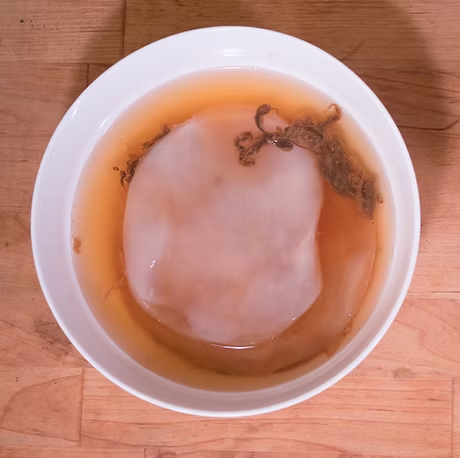
Let’s be blunt: mold is the one thing we don’t play around with.
The good news?
True mold is rare, obvious, and easy to deal with.
If it’s mold, it will look like something you’d see on:
Specifically, Kombucha mold is:
If you see anything that looks like a fuzzy spot on top, treat it as mold. Don’t overthink it.

If we could fix one thing for every struggling brewer, it would be temperature.
Kombucha is a warm-weather ferment. When it’s happy, it protects itself. When it’s chilly, things stall and mold gets an opening.
Below ~70°F / 21°C:
Above ~90°F / 32°C:
You don’t need anything fancy:
Think of temperature as Kombucha’s immune system. When it’s warm and stable, everything else gets easier.
In our shop we have a variety of tools that will make temperature management significantly easier and so much more hands-off… exactly what most people are looking for. From year-round heaters that keep your brew the perfect temperature to heating strips and more, we’ve got you covered.

Using the right ingredients isn’t about being precious; it’s about giving the culture what it knows how to work with. In the same way that some animals are carnivores and some are herbivores, the microbes that make up Kombucha have specific preferences when it comes to the substrate that is best.
That’s it. Kombucha is low maintenance. You don’t have to be perfect about everything in life. With Kombucha, this is one area where following the rules actually makes things easier, not harder.
There’s been a long-running myth that any metal kills Kombucha. That’s… not how chemistry works.
Plastic isn’t a villain, but:
We prefer glass or high-grade stainless for anything long-term.
If the SCOBY is the body, starter liquid is the immune system.
Starter liquid is simply fully fermented, unflavored Kombucha from a previous batch (or from the culture bag when you buy a SCOBY from us).
If you’re ever on the fence: Too little starter liquid is a problem. Too much is just a little extra sour.
Some folks assume fermenting foods need lab-level sterility. Kombucha, on the other hand, was invented in kitchens long before disinfectant wipes.
What you don’t need:
We’re aiming for “regular cooking clean,” not “operating theater.”

(For a more in-depth understanding of this topic, check out our article on How To Avoid Geysers and Explosions.)
This is probably the #1 fear we hear from newer brewers:
“I heard bottles can explode — how do I make sure that never happens in my kitchen?”
Exploding bottles happen when gas builds up faster than it can escape and the container isn’t built for it.
The fridge doesn’t just chill the Kombucha; it slows fermentation way down, which slows gas production and keeps everything comfortable.
Is it possible to make a bottle over-carbonated? Yes.
Is it easy to manage once you know what’s happening? Also yes.
This is where safety overlaps with sensible self-awareness. As long as your know your body and know whether or not something in being tolerated well, you can approach Kombucha like you would any other nutraceutical-like food or beverage. Just like you wouldn’t immediately start supplementing with mega-doses of psyllium husk, pacing yourself and introducing new ferments slowly will always be to your benefit.
For most healthy people, properly brewed Kombucha is extremely safe and well-tolerated.
Where issues usually come from:
Normal adjustment:
Red flag:
If the Kombucha smells clean, tastes good, and was brewed following real guidelines, it’s highly unlikely to be an issue. If your instincts say “this seems wrong,” honor that.
For a deeper dive into how Kombucha interacts with your system, check out our article on Side Effects / Herxheimer Reactions.
We’re not here to play doctor, but we are here to share how most families handle this.
The general rule of thumb:
Always loop in your healthcare provider. Check out our handy Kombucha and Pregnancy Page to help you start the conversation with your obstetrician.
Most kids handle Kombucha beautifully once introduced properly. However, as with all things involving your little ones, it is always best to consult with their pediatrician to ensure that fermented foods are safe and well-tolerated for your little one. Always better to be safe rather than sorry.
Tips:
If you or someone you love is immunocompromised:
The theme here: listen to your body, use common sense, and respect your current state of health.
For further information, start with this research article on the topic from ScienceDirect: https://www.sciencedirect.com/science/article/pii/S2161831325000481
There’s empowering “don’t panic, this is normal” advice… and then there are a few lines we simply don’t cross. It is super important that you are aware of where those lines are and have a standard operating procedure in place for what to do in the event of certain situations. (I know, I know… it sounds so life or death. But it’s important so stick with me and pay attention!)
Throw the batch out if:
You’re not failing as a brewer by discarding a batch.
You’re being a responsible steward of your little microbial universe.
If you can say “yes” to most of these, you are in great shape:
That’s it. That’s the whole secret.
We’ve spent decades helping people overcome fear, misinformation, and bad Google advice so they can enjoy a simple pleasure:
a glass of home-brewed Kombucha that they made themselves.
You don’t have to be perfect. You just have to be aware and consistent.
If you’re ready to brew safely with tools that set you up for success head to the Kombucha Kamp Shop to find:
Your kitchen can absolutely be a safe, thriving little fermentation lab — without the drama.

 family-owned
 over 5,000
  100,000+ happy
  exceptional
  only fresh living
  lots of free articles,