Kombucha Carbonation for Beginners (2025 Guide)

How to Get Fizzy, Bubbly, Effervescent Kombucha Every Single Time

Most people enjoy having at least some bubbles in their Kombucha. A fizzy glass of booch can be fun, adds to the flavor, and offers a “natural soda” type of experience, all of which have helped Kombucha become so popular. But it’s also true that Kombucha carbonation can be a tricky thing to master at first.


Utilizing these tips and tricks will help infuse your brew with more Kombucha carbonation than ever before. Just be careful not to overdo it! (Tips about that below too)


Once you have a routine, bottling a bubbly brew will be second nature!

How to Carbonate Kombucha
Click Here to Explore Our Complete Guide to Second Fermentation

However, if you landed on this page, chances are your Kombucha is either:


  1. A) flatter than your enthusiasm,
  2. B) exploding aggressively
  3. C) wildly inconsistent — fizzy one week, bored the next.

Good news: Carbonation is a skill, not a mystery — and once you understand how it works, it becomes one of the most fun (and forgiving) parts of Kombucha brewing.


At Kombucha Kamp, we’ve helped countless brewers go from “Why is my Kombucha dead inside?” to “I just made natural soda that rivals the store stuff — come over and taste this RIGHT NOW.”


This guide will walk you through:


  • how carbonation actually works
  • how to choose the right bottles
  • how to flavor safely
  • how to avoid flat brews
  • how to avoid bottle bombs (important!)
  • and how to master the art of the perfect F2

Let’s get fizzy.

Why Kombucha Carbonates (The Quick, Friendly Science)

To get good carbonation, you don’t need to memorize chemistry — but a little understanding goes a long way.

Carbonation is created by happy yeast doing three things:

  1. Eating sugar
  2. Producing CO₂ (bubbles!)
  3. Trapping that CO₂ inside a sealed bottle

That’s it. A three-step dance.


Yeast doesn’t care if the sugar comes from:


  • fruit puree
  • fruit juice
  • fresh fruit
  • honey (not during F1!)
  • cane sugar
  • sugar-rich herbs (ginger!)
  • syrups

If yeast has sugar, warmth, and an airtight bottle, it makes bubbles.


The rest is technique.

F1 vs F2: Understanding Where the Magic Happens

Before we talk bottles and flavors, we need to clear up the most common misconception:

F1 (First Fermentation)

The SCOBY lives here. It’s all about:


  • cultivating bacteria
  • balancing yeast
  • forming the new SCOBY layer
  • acidifying the brew for safety

There’s usually light natural fizz, but nothing dramatic.


The SCOBY does produce CO₂, but escapes through the cloth cover.


Let’s call this step “Creating the Base Brew”. This is liquid gold and serves as the canvas for all of your fizzy, flavorful creations.

F2 (Second Fermentation)

THIS is where carbonation is born.


This is your “bottle ferment.”


Here you:


  • bottle the Kombucha
  • flavor it
  • seal it
  • let carbonation build

If Kombucha were beer, F1 would be “brewing,” and F2 would be “conditioning in the bottle.”


All the magic happens here.

Tools You Need for Perfect Carbonation

(And a few to avoid so your bottles don’t turn into grenades.)

✔ BEST BOTTLES

  • Swing-top glass bottles (Grolsch-style)
  • Champagne bottles with crown caps

✔ GOOD (but less ideal)

  • Reused Kombucha bottles, only if:
    • they’re thick
    • the lids are in excellent shape
    • the rubber seals are intact

✖ BAD or UNSAFE

  • Mason jars (not pressure-rated)
  • Thin recycled glass (won’t hold CO₂)
  • Plastic bottles over long-term (scratches harbor bacteria)
  • Cheap dollar-store bottles

If your bottles are flimsy?


Your fizz journey will resemble a crime scene. Seriously – this looks cool on social media, but having to clean fruit, fizz, and yeasty bits off of your ceilings, counters, carpets, and possibly pets… not fun. Trust me.

What Kombucha Needs to Carbonate (Non-Negotiables)

Think of carbonation as a recipe:


Sugar + Yeast + Warmth + Airtight Bottle = Bubbles

You must have:

✔ A healthy F1 (not overly acidic)

✔ Sugar added in F2 (even a little)

✔ Bottles sealed tightly

✔ Warm environment (75–85°F / 24–29°C)

✔ Time

You need none of the following:

✖ Fancy carbonation equipment

✖ Perfect SCOBYs

✖ Sterile conditions

✖ Expensive flavorings


You already have everything you need. Let’s move into flavors — because flavors = sugar = fizz.

Sugar Sources Ranked by Fizz Power

🥇 STRONG FIZZ

  • Fruit juices (grape juice, apple juice)
  • Fresh fruit puree
  • Ginger (a natural carbonation booster)
  • Cane sugar (¼–1 tsp per bottle)

🥈 MODERATE FIZZ

  • Fresh fruit pieces
  • Berries
  • Herbal syrups
  • Honey (for F2 only)

🥉 LIGHT FIZZ

  • Dried fruit
  • Vanilla
  • Herbs without sugar
  • Spices
  • Essential oils (never use these — they kill yeast)

🚫 NO FIZZ

  • Zero-sugar ingredients
  • Artificial sweeteners
  • Flavor extracts only (unless paired with sugar)

If fizz is the goal, always include something fermentable.

Step-by-Step: How to Carbonate Kombucha (The F2 Method)

This is the exact method we teach brewers worldwide:

Step 1 – Fill Bottles

Fill each bottle ¾ of the way with finished F1 Kombucha.

Step 2 – Add Your Sugar Source

Choose:


  • 1–3 tbsp fruit puree
  • 1–2 tbsp fruit juice
  • A few pieces of chopped fruit
  • ¼–1 tsp cane sugar
  • 1–2 tbsp ginger

Don’t overthink it — Kombucha is forgiving.

1 cup of sugar per gallon in this kombucha recipe

Step 3 – Leave Headspace

Leave 1–2 inches at the top.


Too much headspace = weak fizz


Too little = overfizz

Step 4 – Seal the Bottles

Airtight seal = carbonation guaranteed.

Step 5 – Store Somewhere Warm

Carbonation thrives around 75–85°F (24–29°C).

A cold F2 = flat Kombucha

A warm F2 = fizzy, happy Kombucha

Step 6 – Burp Bottles Daily

Especially for:


  • high-sugar flavors
  • warm homes
  • strong yeast activity

Burping = prevent explosions.

Step 7 – Refrigerate to Lock In Bubbles

Once it’s fizzy to your liking, refrigerate to slow fermentation.


Chill = fizz preservation


Warm = continued pressure

Step 8 – Enjoy!

Kombucha should hiss when opened — not scream.

Troubleshooting Flat Kombucha (Fix ANY Flat Brew)

If your Kombucha is flat, it’s for one of these reasons:

Reason #1: F2 was too cold

Cold = sleepy yeast

Solution:

  • Move bottles somewhere warm
  • Use a heat mat / brewers’ belt
  • Extend fermentation time

Reason #2: No sugar was added

Without sugar, yeast has no fuel.

Solution:

  • Add juice, puree, honey, or cane sugar

Reason #3: Weak bottles or bad seals

Store bottles don’t always seal tightly.

Solution:

  • Upgrade to swing-tops
  • Replace old rubber gaskets

Reason #4: F1 was too sour

Very acidic Kombucha = yeast slowdown.

Solution:

  • Shorten your first fermentation
  • Refresh with more sweet tea

Reason #5: Yeast levels too low

Over-strained Kombucha sometimes loses yeast.

Solution:

  • Stir or swirl your F1 gently before bottling
  • Use a more yeast-active batch
  • Add ginger (yeast booster!)

Reason #6: Kombucha was too cold when bottled

Refrigerated Kombucha = no fizz

Solution:

  • Always bottle room-temperature F1

Reason #7: Not enough time

Some batches fizz in 24 hours

Some take 3–7 days

Solution:

  • Be patient

Avoiding Bottle Bombs (Genuinely Important)

Exploding bottles are the #1 carbonation fear — and almost always preventable. We have a more comprehensive guide to avoiding this common pitfall HERE.


Avoid bombs by:

✔ Using thick, pressure-rated bottles

✔ Burping bottles daily (especially with fruit)

✔ Refrigerating promptly once fizzy

✔ Leaving proper headspace

✔ Avoiding over-sugaring

✔ Keeping flavorings consistent


If you’ve ever opened a bottle and it sprayed like a shaken volcano…


Congratulations, you made champagne Kombucha. 🍾


Now dial it back one notch.

Advanced Carbonation Tricks (For Pros Only)

1. Add a pinch of cane sugar per bottle

Not too much — yeast is very enthusiastic.

4. Yeast harvesting

Some brewers collect active yeast from the F1 bottom and add a spoonful to each bottle.

2. Use ginger

Ginger + yeast = sparkle magic.

5. Flavor layering

Layer puree + juice for multi-stage fermentation.

3. Use grape juice

A classic carbonation booster.

6. Bottle conditioning chambers

If you’re fancy (and we love fancy), heat mats for F2 are amazing. We have some great ones in the Kombucha Kamp Shop.

Carbonation Styles: Customize Your Bubbles

Champagne Bubbles

  • Use juice + ginger
  • Ferment slightly longer
  • Keep bottles warm

Soda Bubbles

  • Add more sugar
  • Add puree instead of juice
  • Burp less frequently

Soft Spritz

  • Less sugar
  • Cooler F2
  • More headspace

Carbonation FAQs

“Can Kombucha explode?”

Only if bottled improperly. Use swing-tops, burp daily, refrigerate promptly.

“Why is mine still flat?”

Temperature or sugar is almost always the culprit.

“Why is mine TOO fizzy?”

Too warm + too sugary + too long in F2.

“Can I get carbonation without sugar?”

No. Yeast needs sugar to make bubbles.

“Does carbonation increase alcohol?”

Slightly, but usually under 0.5% ABV.

“Why does the flavor change during carbonation?”

Yeast is still fermenting — it’s alive in the bottle.

Final Thoughts: You Can Master Fizzy Kombucha

Carbonation might seem unpredictable at first, but once you get the hang of:


  • sugar
  • bottle choice
  • temperature
  • timing

…it becomes shockingly easy to make Kombucha that rivals anything sold commercially.


And unlike store-bought brands, yours will be:


✔ fresher

✔ better tasting

✔ customized

✔ naturally carbonated

✔ infused with real ingredients


Use this guide anytime your Kombucha needs a little sparkle in its life.

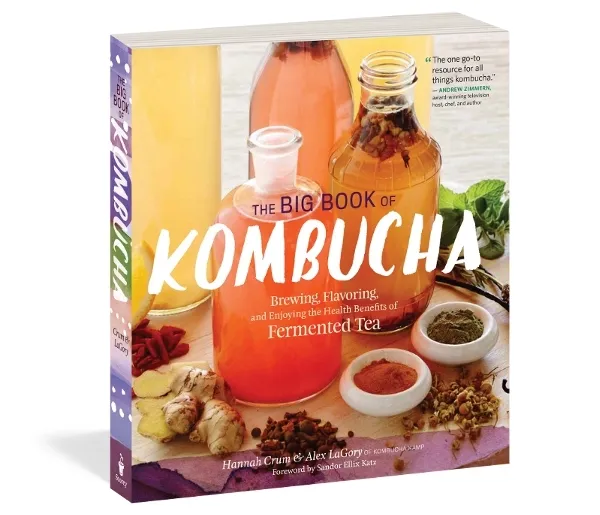
For more tips and tricks on everything from tea selection to carbonation to recipes, click the cover above to grab a copy of The Big Book of Kombucha
Showing 36-40 of 126 products
usa-handmade-stoneware-continuous-brew-jun-deluxe-package
SALE

PACKAGE INCLUDES USA Handmade Stoneware Crock Fine Finish Wood Counter Stand Brew-safe plastic spigot or upgrade to stylish Stainless Steel spigot…

PACKAGE INCLUDES Toasted Oak Barrel Fine Finish Wood Counter Stand Brew-safe plastic spigot or upgrade to stylish Stainless Steel spigot (better…

Capacity
jun-stainless-steel-continuous-brew-kombucha-deluxe-package
SALE

JUN Stainless Steel Continuous Brew Deluxe Package

Original price was: $549.94.Current price is: $368.88. -33%
jun-stainless-steel-continuous-brew-kombucha-deluxe-package
SALE

PACKAGE INCLUDES Stainless Steel Vessel - 304 grade (most corrosive resistant stainless alloy) Fine Finish Wood Counter Stand Brew-safe plastic…

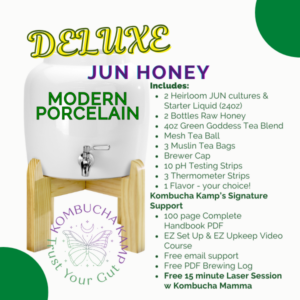
jun-modern-porcelain-continuous-brewer-deluxe-package
SALE

JUN Modern Porcelain Continuous Brewer Deluxe Package

Original price was: $459.94.Current price is: $328.88. -28%
jun-modern-porcelain-continuous-brewer-deluxe-package
SALE

PACKAGE INCLUDES White Modern Porcelain Vessel or choose from Black Knight, Forest Green, or Blue Heaven Fine Finish Wood Counter…

All search results